
Imagine a company’s powerful AI, its Large Language Model (LLM), functioning as a high-performance engine that drives innovation and critical operations, only to be hijacked by cybercriminals, who seize control and weaponize it for data theft, malicious code generation, and other dark, calculated exploits.
The company, oblivious to this intrusion, continues to pay the fuel costs, the cloud consumption fees, while the attackers reap the benefits. This “LLMjacking” is a significant breach, a silent drain on resources, and a severe compromise of sensitive data, all happening under the guise of normal operational costs!
How are LLMjacking attacks executed?
Threat actors employ various techniques to execute LLMjacking attacks, exploiting different aspects of how these models are integrated and secured. These methods often involve subtle manipulation or the leveraging of existing vulnerabilities within the AI ecosystem.
- Command Injection
Attackers secretly embed malicious commands within normal interactions or API calls, deceiving the AI into executing them. Resulting in unauthorized disclosure of sensitive data accessible to the LLM. - API Vulnerability Exploitation
Given the reliance of AI models on APIs for external service connectivity, inadequately secured APIs present exploitable access vectors. Threat actors leverage weak authentication protocols or compromised API keys to gain access, enabling data exfiltration or service disruption. - Model Training Data Tampering
This technique involves subtly inserting malicious data into the AI’s training dataset, gradually shaping the model’s output to introduce biases or manipulate behavior in ways that serve an attacker’s goals, all while avoiding detection.
The danger of LLMjacking intensifies when attackers sell stolen access to a wider network of cybercriminals. This fuels a black market where compromised LLMs become multipurpose weapons, enabling countless attackers to launch diverse, unpredictable threats from a single breach.
Recently a Security Research Team’s investigation into LLM access exploitation revealed a case involving AWS Bedrock prompt and response logging. Their findings showed a Russian individual utilizing compromised AWS credentials to access a Claude model hosted on Bedrock. By combining these stolen credentials with a bot infrastructure located outside of Russia, the attacker successfully gained access to the LLM.

How Gauntlet Helps Defend Against LLMjacking
In today’s rapidly evolving AI threat landscape, traditional cybersecurity frameworks are no longer sufficient. Attacks like LLMjacking, where adversaries hijack access to large language models (LLMs) for malicious gain, require AI-native defenses built from the ground up.
Gauntlet rises to this challenge by offering a multi-layered, AI-centric security designed specifically to safeguard enterprise AI systems.
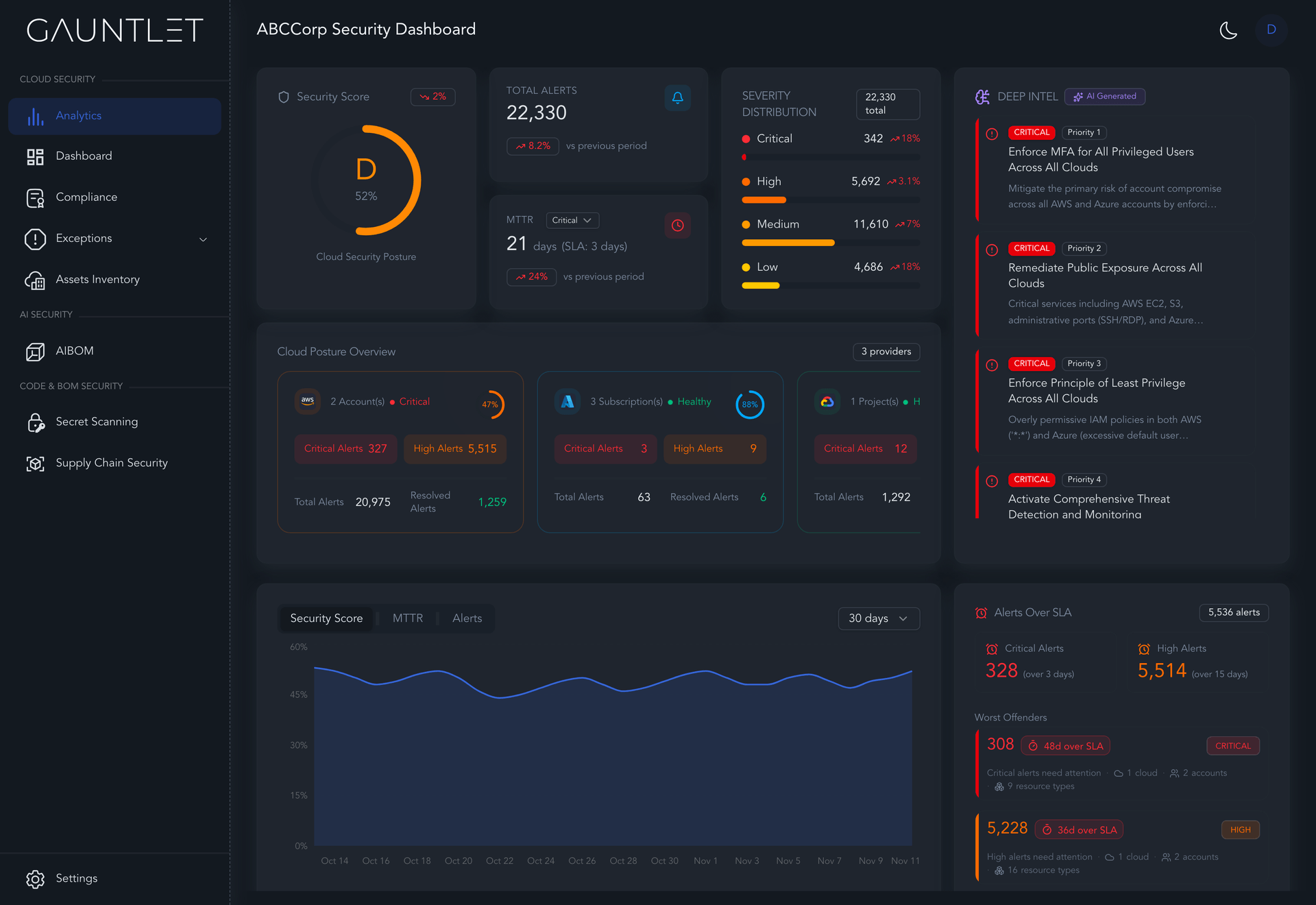
At the heart of Gauntlet’s defense strategy is its AI Security Posture Management (AISPM). This system goes beyond generic configuration checks and applies context-aware guardrail checks across all runtimes.
Whether it’s enforcing secure API configurations, monitoring role-based access controls, or validating policy compliance, AISPM ensures your AI infrastructure is aligned with security best practices and regulatory standards.
A key tenet Gauntlet ensures to enforce is the principle of least privilege. This means each user, process, or service within your AI environment is granted only the minimum level of access required to perform its function.
Gauntlet drastically reduces the attack surface, ensuring that even if credentials are compromised, the extent of potential damage is minimized.
But Gauntlet doesn’t stop there. Its continuous secret scanning engine constantly scans source code to detect hardcoded credentials, exposed API keys, authentication tokens, that may inadvertently be pushed into repositories or logs.
These secrets, if leaked, are prime entry points for LLMjacking attacks. By identifying and alerting them in real time, Gauntlet enables organizations to remediate risks before they can be exploited.
Gauntlet automatically generates a comprehensive AI Bill of Materials (AI BOM), a transparent inventory of all AI third-party packages, and dependencies. This visibility is critical in complex environments where LLMs often rely on external or open-source components. Gauntlet doesn’t just document these components, it continuously monitors them for known vulnerabilities, issuing alerts when a security issue is discovered in any dependency, ensuring rapid response and patching.
Gauntlet enables enterprises to stay ahead by preventing attacks like LLMjacking before they ever take root.
Simplify AI Security with Gauntlet today!
Reach out to us via www.gauntlet.security, and ask us about our free, no-obligation trial program to learn how Gauntlet can secure your solutions today.
Author: Anand V A
Sources:
The Growing Dangers of LLMjacking: https://sysdig.com/blog/growing-dangers-of-llmjacking/
LLMjacking: Stolen Cloud Credentials Used in New AI Attack: https://sysdig.com/blog/llmjacking-stolen-cloud-credentials-used-in-new-ai-attack/
This article was first published on the Gauntlet blog on Medium.