
GitGuardian reports that approximately 28% of credential incidents originated entirely outside traditional code repositories, highlighting how secrets now move through the entire software development workflow rather than remaining inside Git repositories alone. Modern AI development accelerates this trend. Every chatbot, coding assistant, MCP server, automation workflow, or AI-powered application introduces another credential that developers must manage securely. AI doesn’t make credentials inherently less secure; it simply increases the number of credentials being created and the speed at which they move through development environments.
What Are AI API Keys, Really?
When developers build products powered by AI models, whether Claude, GPT-4, Gemini, or others, they authenticate through API keys. Most providers issue similar credential types, and the differences between them matter enormously from a security standpoint. Standard API keys are the everyday credentials developers use to send requests to an AI model. They power chatbots, coding tools, content workflows, and countless AI integrations. These keys are typically tied to an account or workspace, a logical container that lets organizations separate usage by team, product, or environment. Admin or elevated-privilege keys are a different matter entirely. These allow organizations to programmatically manage members, accounts, billing, and API keys, tasks that would otherwise require manual configuration in a console. Only certain privileged members can provision these keys. An admin key doesn’t just let you use the AI service; it lets you control who in your organization gets to use it, at what spend, and under what permissions. The distinction is critical. A leaked standard API key is a serious problem. A leaked admin key is a potential organizational takeover.

What Actually Happens When an AI API Key Leaks?
The consequences aren’t abstract; they’re immediate, financial, and sometimes silent.
Billing fraud hits first. Stolen keys can rack up massive charges. One developer woke up to an $82,314 bill after 48 hours of fraudulent usage; their normal monthly spend was $180. The rule is simple: providers secure the infrastructure; you secure the key.
The damage goes beyond the bill:
- Attackers can embed their API keys in prompt injections, turning legitimate AI connections into data-exfiltration channels without human approval.
- Stolen keys can impersonate your application, abuse rate limits, or quietly run workloads for weeks.
Admin keys carry even greater risk. Anthropic Admin API Keys provide revocable read-write access without finer permission scoping. An attacker can create or deactivate keys, reassign workspace members, and inventory your AI infrastructure through legitimate API calls.
The standard key costs you money. The admin key costs you control.
The AI Coding Tools Problem Nobody Anticipated
Here’s where things get uncomfortable: the tools teams use to move faster can also increase credential exposure. Claude Code co-authored leaked secrets at 3.2% in 2025, more than double the human-only rate of 1.5%. AI-assisted commits are also larger, creating more surface area for accidental leaks. Since coding tools read your codebase, configuration, and environment for context, they operate where credentials often hide. As development speeds up, so does the risk of a credential making it into a commit.
Finding Secrets and Stopping Them Are Two Different Things
Here’s the real issue: 64% of secrets confirmed valid in 2022 were still active and exploitable when retested in January 2026. That’s not a detection problem; it’s a remediation problem. Finding a credential means little if you don’t know who owns it, what it can access, or how to revoke it.
The blind spot is also bigger than code. About 28% of secret incidents in 2025 originated outside code repositories, including Slack, Jira, and Confluence.
Detection finds the problem. Remediation closes it. The goal is knowing where a credential exists, whether it’s valid, who owns it, and how quickly it can be revoked.
Where Platform Security Ends and Your Responsibility Begins
Leading AI providers scan public repositories for exposed credentials, deactivate compromised keys, and recommend workspace segmentation, separate credentials, spending limits, and usage monitoring. But these controls mainly address obvious public leaks. Credentials also slip into private repos, CI/CD pipelines, and cloud environments. Organizations stay ahead by continuously scanning code and cloud environments, validating whether exposed secrets are exploitable, and acting before they can be weaponized.
Closing the Gap: What Gauntlet Secret Scanning Does
The difference between a leaked credential and a breach is response time: knowing the secret exists, knowing it’s exploitable, and acting quickly.
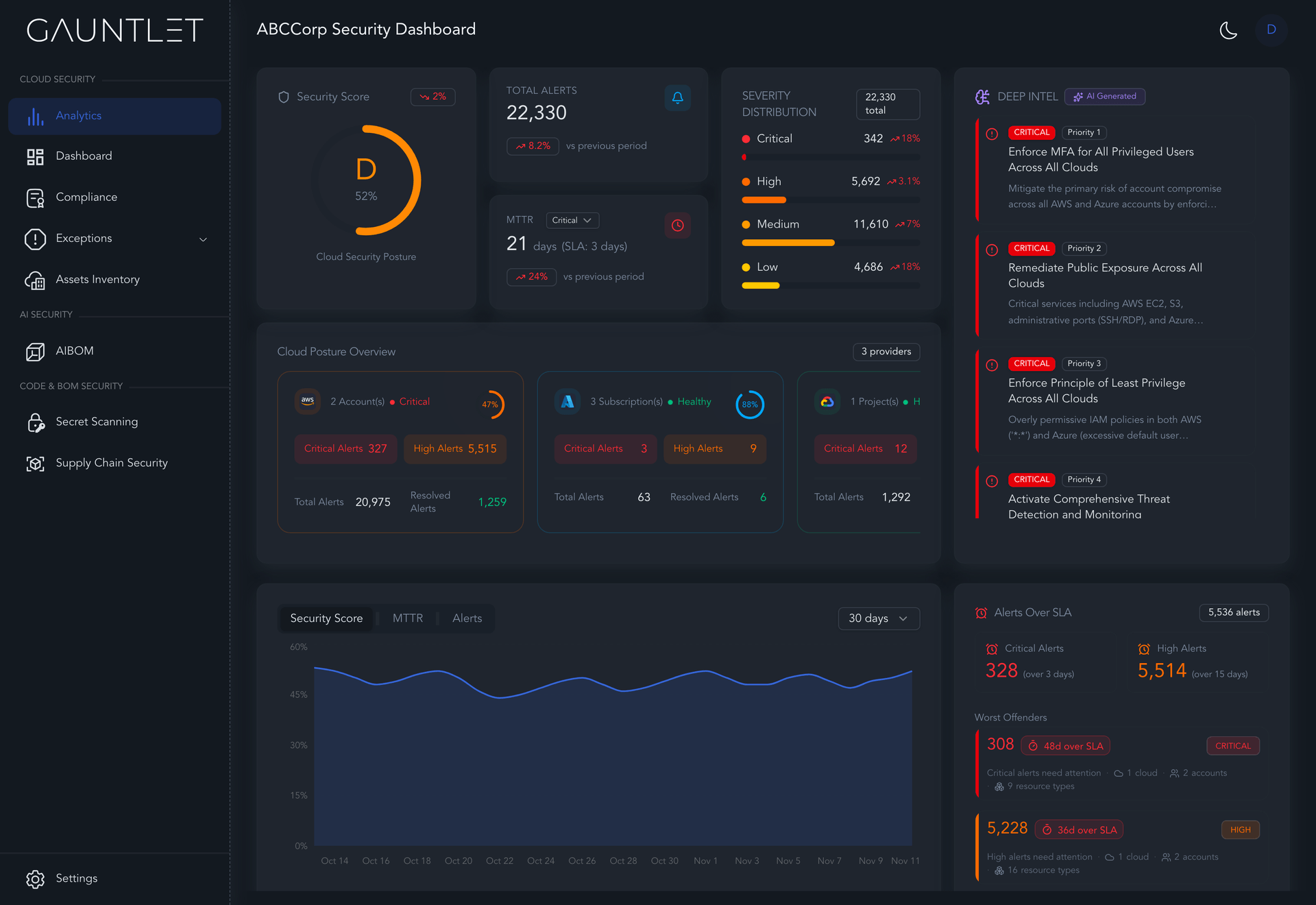
Most scanning tools flood teams with false positives, revoked keys, and test credentials, burying real threats. Gauntlet takes a different approach, continuously scanning repositories and cloud environments while validating each finding for whether it’s real, active, and exploitable. Only verified threats reach your security team.
This matters even more for AI. Every AI integration, agentic workflow, and MCP server adds credentials to manage. Gauntlet not only identifies verified leaks but also reveals recurring patterns across repositories, environments, and teams — helping fix the root cause.
With real-time alerts and one unified platform, teams can act in minutes instead of weeks.
Sources
- GitGuardian 2026 State of Secrets Sprawl Report: AI service credential leaks (81% YoY growth, 1.275M incidents), secrets detection statistics
- Beyond Identity The Attacker Gave Claude Their API Key API key exploitation scenarios and security risks
- CloudSEK Hardcoded Google API Keys in Top Android Apps: Billing fraud and unauthorized API usage incidents
- GitLab Application Security DAST Browser Checks Secret detection methodologies
- Anthropic — Vantage Admin key permissions and access scope
- TurboGeek AI-assisted commit leak rates and remediation gap
- The Hacker News Collaboration tool exposure and critical incident data
This article was first published on the Gauntlet blog on Medium.