
The Rising Tide of Cyber Threats in MedTech
In 2024, the healthcare sector witnessed an unprecedented surge in cyberattacks, underscoring the vulnerabilities inherent in modern medical technologies. The ransomware attack on Change Healthcare disrupted services nationwide, compromising sensitive patient data and leading to a $22 million ransom payment.
Similarly, Ascension Health System, one of the largest nonprofit health networks in the U.S., faced operational disruptions due to a ransomware attack, impacting patient care across its hospitals and clinics.
Cybersecurity in MedTech is no longer optional. When patient safety, trust, and compliance are at stake, proactive defenses are critical.
Why is MedTech a prime target
MedTech (Medical Technology) refers to the growing class of digital systems, devices, and platforms used to improve patient care, streamline diagnostics, and enhance operational efficiency in healthcare.
These innovations include:
- Patient record systems (EHRs/EMRs)
- Remote patient monitoring tools
- IoT-enabled devices like insulin pumps and smart ECGs
- Imaging systems such as connected X-ray, MRI, and CT machines
- AI-driven diagnostic tools for radiology, pathology, and more

These technologies are transforming care, but they also introduce a sprawling attack surface across hardware, software, and the cloud.
The Unique Cybersecurity Challenges in MedTech
Cloud Infrastructure Vulnerabilities
The Change Healthcare attack revealed the consequences of weak cloud configurations and the absence of multi-factor authentication. The incident affected nearly 100 million individuals, demonstrating the need for Cloud Security Posture Management (CSPM) tools that prevent misconfigurations and credential misuse.
AI-Driven Diagnostics
AI models are susceptible to model inversion attacks, where adversaries reconstruct sensitive training data. As more MedTech companies adopt AI, securing inference endpoints and model integrity is crucial.
Software Supply Chain Attacks
The HSE ransomware attack in Ireland originated from compromised software dependencies, highlighting how supply chain risks can cripple health systems.
Gauntlet: A Comprehensive Security Solution for Cybersecurity & Compliance
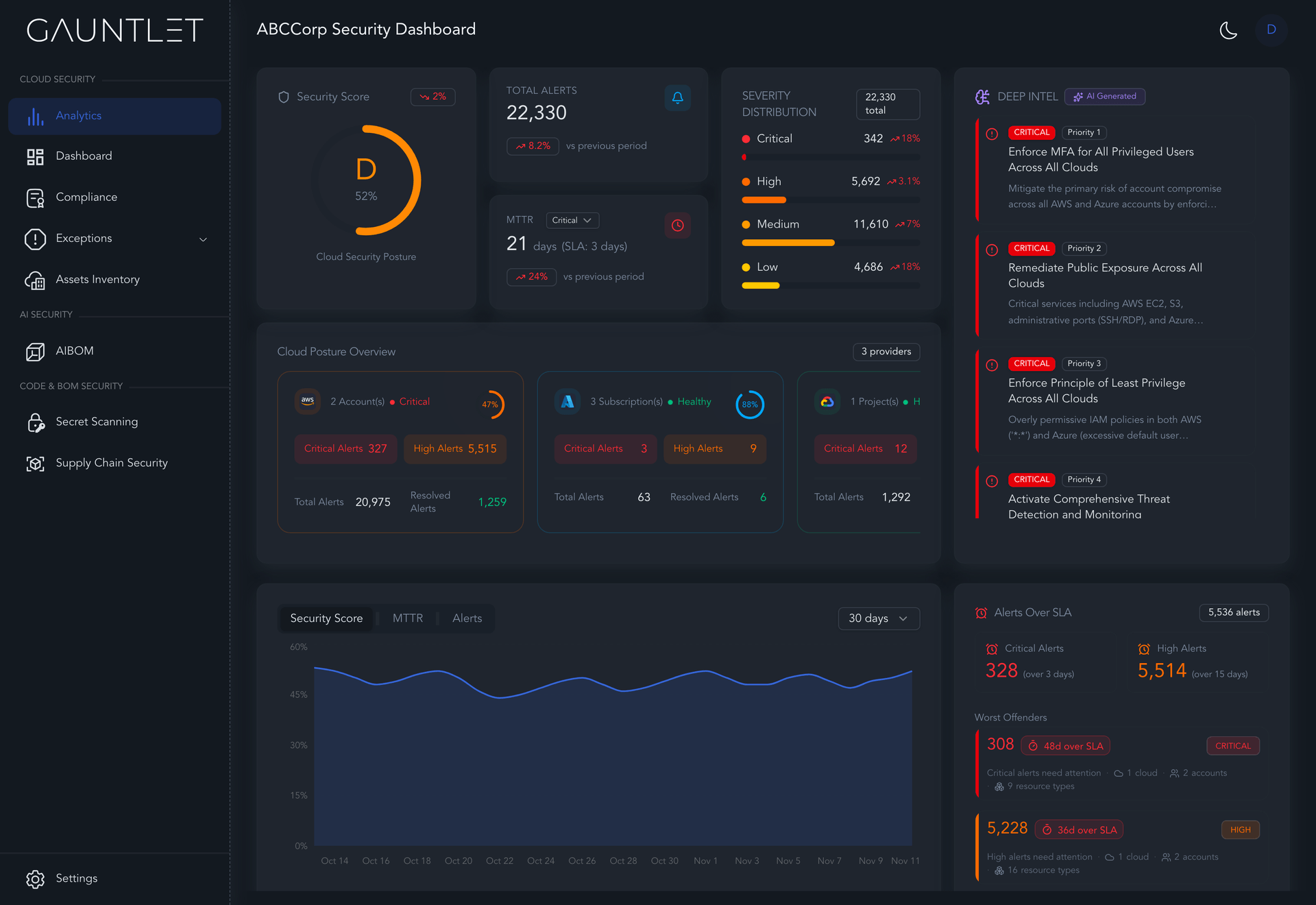
Gauntlet delivers tailored security solutions for the fast-evolving needs of MedTech innovators. It addresses the critical technical and regulatory challenges posed by cloud adoption, AI integration, and software supply chains, while ensuring alignment with industry standards such as HIPAA, FDA 510k Cybersecurity Guidance, and ISO 14971/27001.

Gauntlet’s Compliance Centric Approach
For MedTech organizations operating in regulated environments, maintaining a secure and compliant cloud infrastructure is not just a technical concern; it’s a regulatory mandate. Gauntlet’s CSPM offers real-time visibility and policy enforcement across AWS, Azure, and GCP hyperscalers, enabling organizations to continuously assess risks, fix misconfigurations, and demonstrate compliance with industry standards.
Protecting ePHI and ensuring HIPAA compliance
The Health Insurance Portability and Accountability Act (HIPAA) requires covered entities and their business associates to implement comprehensive safeguards for electronic Protected Health Information (ePHI).
Here’s how Gauntlet supports HIPAA compliance:

FDA 510(k) & Premarket Submissions Guidance (2023)
To meet FDA expectations for cybersecurity in medical devices, manufacturers must ensure compliance with regulatory pathways like 510(k), De Novo, and PMA. For 510(k) submissions in particular, the FDA emphasizes the need for robust cybersecurity measures, including the implementation of a Secure Product Development Framework (SPDF), threat modelling, and postmarket management of vulnerabilities.
Gauntlet helps medical device manufacturers align with these regulatory requirements by:
- Continuously monitoring deployed medical devices to ensure they meet established security baselines, supporting both premarket and postmarket cybersecurity requirements.
- Providing comprehensive evidence of risk assessments, vulnerability mitigation strategies, and system hardening efforts, which can be directly incorporated into the 510(k) submission to demonstrate compliance with FDA cybersecurity expectations.
- Supporting documentation and reporting that fulfills FDA guidance for cybersecurity readiness and postmarket surveillance, making it easier for manufacturers to demonstrate due diligence and regulatory alignment.
- Compliance with FDA 21 CFR Part 11 ensures electronic records and signatures in FDA-regulated industries are secure, reliable, and legally equivalent to paper records.
By integrating Gauntlet into the medical device development lifecycle, manufacturers can confidently build, monitor, and document secure systems that are compliant with 510(k) cybersecurity requirements — ultimately accelerating approval timelines and improving patient safety.
ISO/IEC 27001
ISO/IEC 27001 is an international standard for information security management systems (ISMS) that requires continuous risk assessment, access control policies, and security monitoring. Gauntlet helps enterprises, financial institutions, healthcare providers, and government agencies adhere to this standard by mapping its real-time security assessments to ISO control objectives, generating audit-ready reports and dashboards, and enabling the demonstration of due diligence and continuous improvement core principles of ISO compliance.
Strengthening AI and Software Supply Chain Security in MedTech
Gauntlet enhances MedTech cybersecurity by delivering robust protections for AI systems, supply chains, and sensitive credentials.
It supports AI Security Posture Management (AISPM) by monitoring cloud hosted AI Resources for privacy risks like PHI exposure, defending against model inversion and adversarial attacks, controlling access to inference endpoints, and logging AI activities for forensic review.
These controls help MedTech companies align with key compliance frameworks such as the FDA’s AI/ML Software as a Medical Device (SaMD) framework, HIPAA’s Privacy Rule, especially in preventing re-identification.
Gauntlet automates Software Bill of Materials (SBOM) generation and continuously scans for vulnerabilities, ensuring secure BOM in compliance with FDA.
Gauntlet proactively detects and manages secrets like API keys and credentials across cloud and codebases. These features not only help meet HIPAA technical safeguards and FDA cybersecurity premarket expectations but also improve overall security posture.
Gauntlet delivers these capabilities as part of a unified solution, helping MedTech organizations stay compliant while addressing emerging cyber risks.
Conclusion: Building Resilient, Compliant, and Secure MedTech Systems
As cyber threats continue to grow in frequency and sophistication, MedTech organizations cannot afford to treat cybersecurity as an afterthought. From protecting cloud infrastructure and AI models to securing the software supply chain, a proactive and integrated security strategy is essential not just for regulatory compliance but for patient safety, data integrity, and operational continuity.
Gauntlet equips MedTech companies with the tools needed to meet these demands head-on. By embedding security across every layer of the technology stack from development to deployment, Gauntlet ensures continuous risk mitigation, real-time compliance alignment, and readiness for evolving regulations like HIPAA, FDA 510(k), and ISO/IEC 27001. With Gauntlet, MedTech innovators can confidently bring secure, compliant, and transformative healthcare technologies to market, fortifying both innovation and trust in the digital age of medicine.
Sources
HIPAA Security Rule Summary
Securing the software supply chain
HSEs System
Digital Health at Risk
Author: Usha Prakki
This article was first published on the Gauntlet blog on Medium.