
Tracking, prioritizing and patching vulnerabilities in your Software Bill of Materials (SBOM) is a growing problem across industry verticals. With thousands of Common Vulnerabilities and Exposures (CVEs) published every year, software teams struggle with identifying applicable vulnerabilities and patching them. Relying solely on Common Vulnerability Scoring System (CVSS) scores is no longer sufficient. To stay ahead, organizations need a smarter approach powered by consolidating threat intelligence, predictive analytics, and contextual relevance.
That’s where three critical frameworks come into play: Exploit Prediction Scoring System (EPSS), Known Exploited Vulnerabilities (KEV), and Vulnerability Exploitability eXchange (VEX). Together, they shift vulnerability management from a reactive, volume-based effort to a risk-informed, strategic process.
KEV: Known Exploited Vulnerabilities Catalog
KEV is a public catalog maintained by CISA listing CVEs that have been confirmed as exploited in real-world attacks. It draws from government, private sector, and open-source intelligence to identify vulnerabilities actively being used by adversaries.
If a vulnerability appears in KEV, it is not a theoretical risk. Suck vulnerabilities are likely being used in the wild. That confirmation gives security teams a clear signal to act. KEV provides:
- Actionable, high-confidence intelligence
- A basis for mandatory remediation timelines in federal environments
- A direct connection between CVEs and ongoing threat campaigns
EPSS: Exploit Prediction Scoring System
EPSS provides a probability score that estimates the likelihood a vulnerability will be exploited in the wild within the next 30 days. It leverages a range of inputs, including historical exploit data, CVE characteristics, and threat intelligence, to forecast exploitability.
Why it matters
Not all vulnerabilities are equally likely to be exploited. EPSS helps security teams prioritize based on actual risk rather than static severity. A CVE with a medium CVSS score may have a high EPSS score signaling imminent threat. This predictive model allows organizations to:
- Focus patching efforts on vulnerabilities likely to be weaponized
- Reduce unnecessary work on low-risk CVEs
- Minimize time-to-remediation for high-probability threats
Read more: EPSS
Recent developments
In early 2025, EPSS scores spiked for several VPN-related vulnerabilities, including:
- CVE-2024–21762 — Fortinet FortiOS Out-of-Bound Write Vulnerability.
- CVE-2024–21887 — Ivanti Connect Secure and Policy Secure Authentication Bypass Vulnerability
- CVE-2024–20359 — Cisco ASA and FTD Privilege Escalation Vulnerability
Shortly after, the Cybersecurity and Infrastructure Security Agency (CISA) added these CVEs to the Known Exploited Vulnerabilities (KEV) catalog, confirming their use in targeted phishing and credential theft campaigns aimed at government and critical infrastructure sectors.
The alignment between high EPSS scores and KEV inclusion underscores the importance of adopting a risk-driven approach. Organizations that actively monitored EPSS trends were able to proactively escalate remediation efforts, often before widespread exploitation occurred. This demonstrates how intelligence-led prioritization can significantly reduce exposure and improve response times.
VEX: Vulnerability Exploitability eXchange
The Vulnerability Exploitability eXchange (VEX) is a machine-readable and human-readable format designed to communicate whether specific vulnerabilities (CVEs) actually affect a particular software product or environment. Developed as part of the broader SBOM (Software Bill of Materials) ecosystem, VEX helps software producers and consumers reduce ambiguity by adding crucial context to vulnerability disclosures.
Unlike traditional CVE entries — which only declare the existence of a vulnerability in a component — VEX goes a step further by assessing exploitability in the actual deployed context. This is critical, as many vulnerabilities may not be exploitable depending on how the software is configured, used, or bundled.
Why VEX Status Labels Matter
To standardize communication and reduce confusion, VEX uses a set of four explicit status labels for each CVE in a product:
- Not Affected: The component may contain the vulnerability, but due to usage, configuration, or environment, the product is not impacted. No action is required.
- Affected: The vulnerability does impact the product as used or configured. Action such as patching, mitigation, or upgrade is needed.
- Fixed: The vulnerability was previously present and exploitable but has been remediated in a specific product version.
- Under Investigation: The vendor is still assessing whether the vulnerability affects the product. Final status is pending.
Recent Developments in VEX Adoption
As of early 2025, the adoption of Vulnerability Exploitability eXchange (VEX) documents is gaining momentum among software vendors, though widespread implementation is still in progress. Notably:
- Red Hat has made significant strides by publishing VEX files for every CVE associated with their products.
- Google Cloud has introduced support for VEX data within their Artifact Analysis tool. This feature allows users to load VEX files into Artifact Registry, enabling the assessment of whether vulnerabilities are relevant to specific artifacts.
Comparative Summary: EPSS, KEV, and VEX

Gauntlet’s Next Frontier: Intelligence-Driven Supply Chain Security
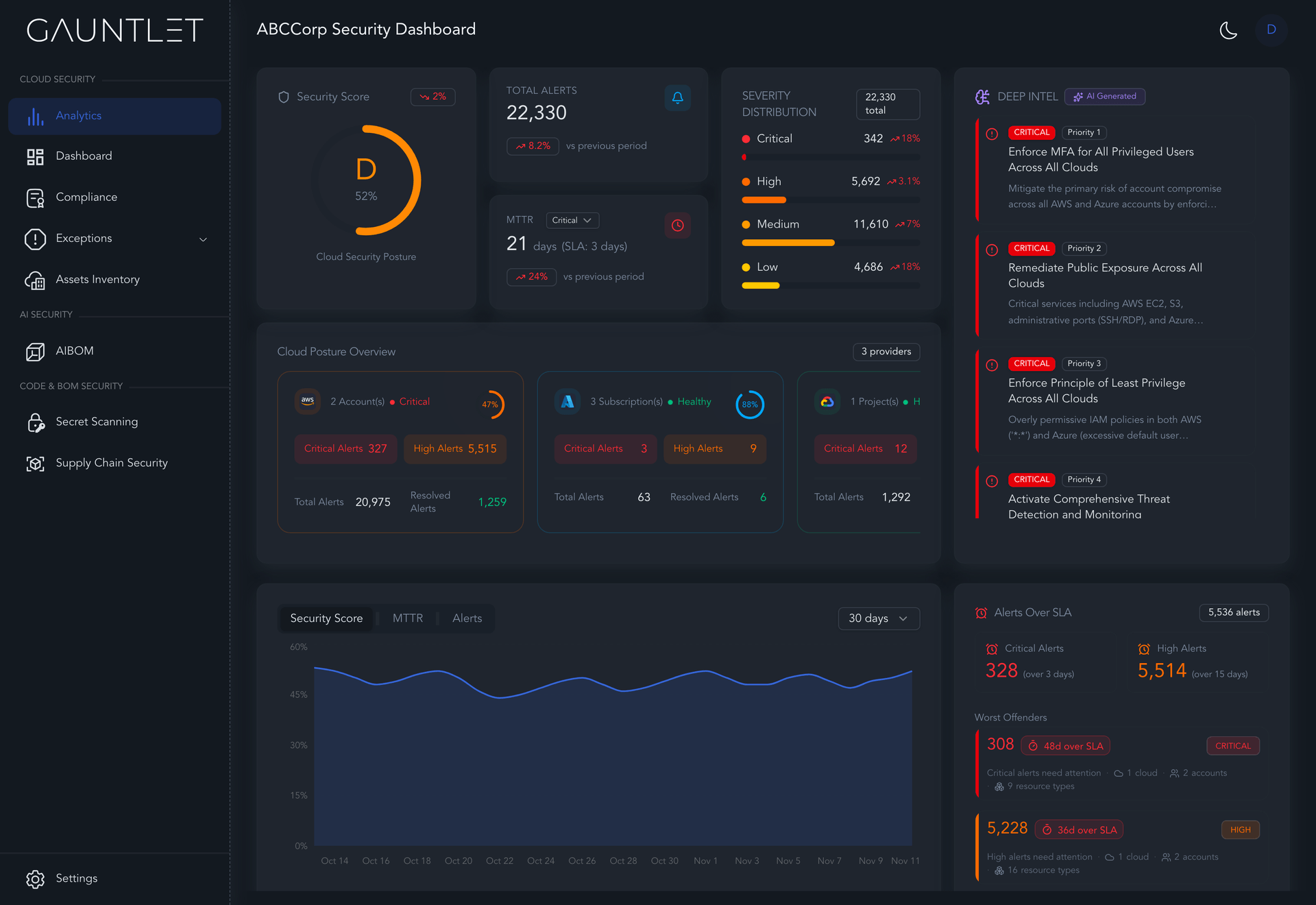
Gauntlet, an advanced security application, is transforming supply chain protection by combining real-time threat detection with emerging risk intelligence frameworks. This evolution enables organizations to focus remediation efforts on vulnerabilities that truly matter.
Gauntlet already empowers security teams with instant visibility into whether a software package is exploitable or contains malware, using clear dashboard indicators - Exploitable: true/false and Malware: true/false. These actionable insights help teams quickly identify high-risk components and prioritize fixes with precision.

Building on this strong foundation, Gauntlet is now in the process of integrating EPSS, KEV, and VEX frameworks directly into its core platform to deliver even deeper threat intelligence. This offers the following benefits to our customers:
- Prioritization of open-source and third-party CVEs using EPSS scores
- Real-time monitoring of KEV updates for actionable threat intelligence
- Contextualized exploitability analysis through VEX integration in SBOM
This intelligence is being fused into Gauntlet’s automated decision-making engine to guide patching, threat detection, and access control policies. By building a next-generation SBOM enriched with real-world risk signals, Gauntlet is setting the standard for proactive, focused, and efficient cybersecurity across the supply chain.
Final Thoughts: Why Intelligence-Driven Security Matters
In today’s fast-moving threat landscape, sticking to traditional vulnerability management like patching everything based only on CVSS scores just does not work. Cyberattacks are evolving, and threat actors are quick to exploit known weaknesses, sometimes just hours after a vulnerability is made public.
Ignoring intelligence frameworks like EPSS and KEV can lead to serious consequences:
- Getting hit by ransomware or zero-day attacks
- Experiencing costly data breaches or system outages
- Facing fines and legal trouble from not meeting compliance requirements
Patching every CVE without understanding its real-world risk wastes time and distracts from fixing the issuesPatching every CVE without understanding its real-world risk leads to wasted effort and delays in addressing truly critical issues. What security teams need is not more alerts, but clearer insights into which vulnerabilities present real danger and which ones can be safely deprioritized
That’s where EPSS, KEV, and VEX come in. These frameworks give security teams a smarter way to prioritize by:
- EPSS predicting which CVEs are likely to be exploited soon
- KEV showing which vulnerabilities are already being used in real-world attacks
- VEX helping filter out CVEs that don’t actually affect your systems or products
Sources:
CISA KEV Catalog: https://www.cisa.gov/known-exploited-vulnerabilities-catalog
CISA Binding Operational Directives: https://www.cisa.gov/news-events/directives
EPSS Project Overview
Red Hat: VEX Files for CVEs Now Generally Available
Google Cloud: How VEX Helps SBOMs Improve Supply Chain Visibility
This article was first published on the Gauntlet blog on Medium.